24 Hours in Bratislava: The Ultimate Walking Tour & Day Trip Guide
✨ This article was AI edited. Editorial responsibility: Magazine of Travel.
A well-structured 24 hours in Bratislava is the ideal duration to capture Slovakia’s capital: a compact, historic pedestrian core, panoramic views from the four-towered coronation castle, and an emerging Central European culinary scene. Located just 60 kilometers downriver from Vienna and 200 kilometers north of Budapest, Bratislava provides exceptional cultural return for minimal transit overhead.
How Should You Structure a 24-Hour Bratislava Walking Circuit?
Bratislava’s historical epicenter—Staré Mesto (Old Town)—occupies less than one square kilometer. This high density allows travelers arriving in the morning to complete a comprehensive walking loop on foot without relying on taxis or metro systems.
| Time Window | Primary Landmark / Activity | Location & Distance | Estimated Cost |
|---|---|---|---|
| 08:30 – 09:30 | Arrival at Hlavná Stanica & Morning Espresso | Tram 1 to Námestie SNP (1.4 km) | €0.90 (Transit ticket) + €3.20 (Coffee) |
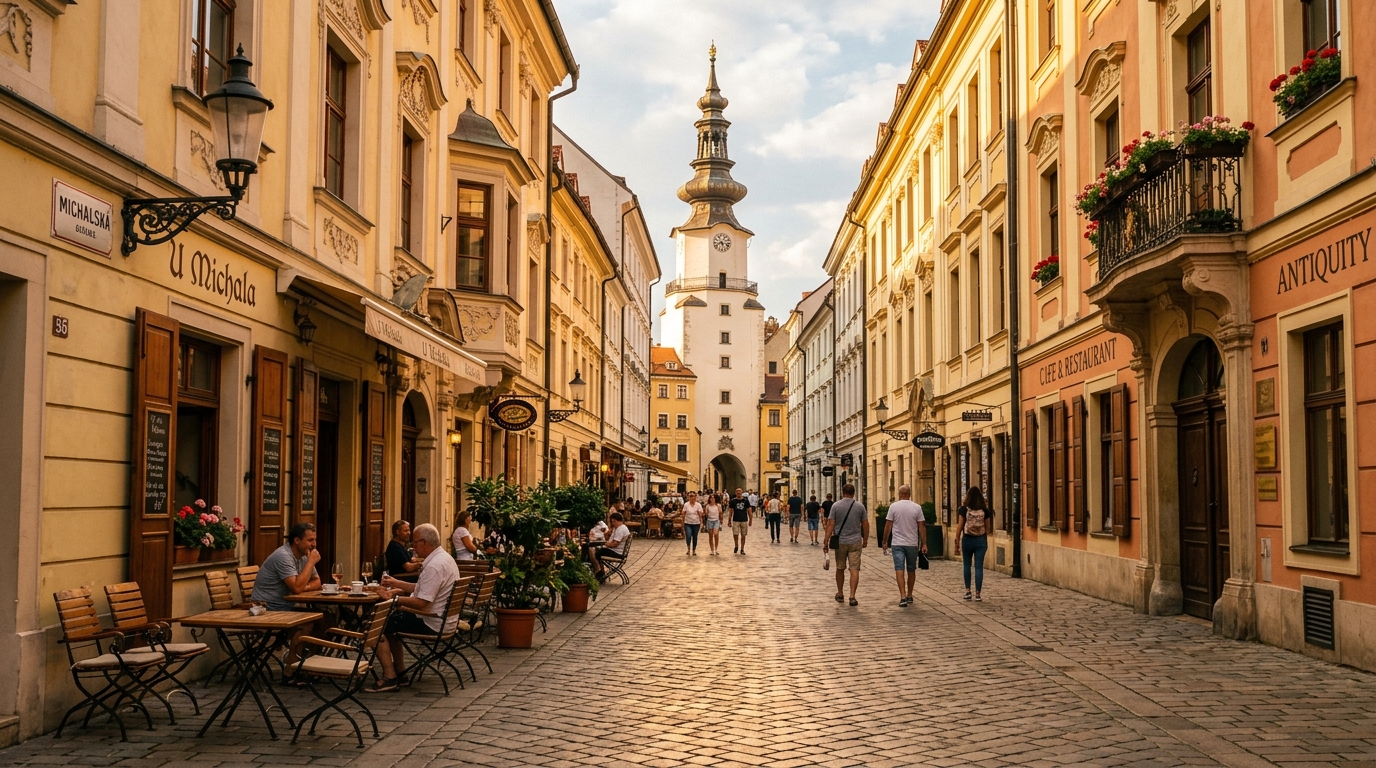
| 09:30 – 11:00 | Old Town Core & Michael’s Gate Walk | Michalská Street to Hlavné Námestie | Free (€6.00 for Michael’s Tower museum) |
| 11:00 – 12:30 | St. Martin’s Cathedral & Coronation Route | Rudnayovo Námestie (400m walk) | Free entry (Crypt €4.00) |
| 12:30 – 14:00 | Traditional Slovak Lunch (Bryndzové Halušky) | Bratislavský Meštiansky Pivovar | €14.00 – €18.00 per person |
| 14:00 – 16:30 | Bratislava Castle Hill & Baroque Gardens | Hradný vrch (15 min uphill walk) | Grounds: Free / Castle Museum: €14.00 |
| 16:45 – 18:00 | The Blue Church (St. Elizabeth) & Art Nouveau District | Bezručova 2 (950m east of center) | Free exterior viewing |
| 18:30 – 20:30 | Danube Riverbank & Sunset from UFO Bridge | Most SNP Tower (85m observation deck) | €11.90 (Observation deck entry) |
| 20:30 – Late | Evening Wine Cellars & Carpathian Frankovka | Ventúrska Street cellars | €15.00 – €25.00 |
Morning in Staré Mesto: Historic Gates and Coronation History
Begin your exploration at Michael’s Gate (Michalská brána), the only preserved medieval gate of Bratislava’s 14th-century fortification system. Freshly restored, its 51-meter copper-roofed tower houses the Museum of Weapons. At the threshold below the gate arch lies the “Kilometer Zero” brass rosette, measuring the physical distance to 29 world capitals.
Walking southward along Michalská street leads directly into Hlavné Námestie (Main Square). The square is anchored by the 14th-century Old Town Hall (Stará radnica) and the Roland Fountain (Maximilian Fountain), erected in 1572 by Emperor Maximilian II to provide drinking water following his royal coronation. Check the southeastern corner of the square to photograph the bronze statue of Napoleon’s Soldier leaning casually over a park bench.
Continue two blocks southwest to St. Martin’s Cathedral (Dóm sv. Martina). Between 1563 and 1830, when Ottoman forces occupied Buda, this three-nave Gothic cathedral served as the official coronation church of the Kingdom of Hungary. Nineteen monarchs—including Empress Maria Theresa—received the Crown of Saint Stephen beneath its vaulted ceilings. A 300-kilogram gold-plated replica of the Hungarian royal crown sits atop the 85-meter spire, serving as a permanent historical marker of the city’s imperial heritage.
Midday Culinary Immersion: Authentic Slovak Gastronomy
Slovak cuisine is deeply hearty, calibrated for alpine climates and agricultural labor. Avoid tourist traps directly fronting Main Square and head to Bratislavský Meštiansky Pivovar (Drevená street location) or Slovenská Reštaurácia.
Your quintessential order must include:
- Bryndzové Halušky: Fresh potato dumplings tossed with creamy bryndza (a sharp, cured sheep’s milk cheese native to the Slovak Carpathians) and topped with crisp smoked bacon lardons.
- Kapustnica: A rich, sour cabbage soup simmered with smoked pork knuckle, dried forest mushrooms, and paprika sausages, traditionally served with dense rye bread.
- Zlatý Bažant ’73: Slovakia’s premier lager, cold-brewed in Hurbanovo with high residual malt density.
Expect a full midday meal with local beer to cost between €14.00 and €18.00 per person. For a comprehensive overview of daily budgeting, card acceptance, and dining rates across the country, consult our in-depth Slovakia travel costs and Euro currency guide.
Afternoon Climb: Bratislava Castle and Panoramic Danube Vistas
From St. Martin’s Cathedral, cross the footbridge traversing the Staromestská arterial roadway to begin the ascent up Castle Hill (Hradný vrch) via the cobbled Beblavého street.
Standing 85 meters above the Danube River, Bratislava Castle (Bratislavský hrad) dominates the regional skyline. Known locally as the “upside-down table” due to its symmetrical four-corner tower design, the castle served as a fortified Roman outpost, a Great Moravian stronghold, and later Maria Theresa’s royal residence.
While access to the Slovak National Museum inside the castle palace requires an entrance ticket of €14.00, the expansive castle grounds, defensive bastions, and reconstructed French Baroque formal gardens are completely free to the public. From the southern terrace, you can gaze across the Danube into Austria to the west and Hungary to the south on clear days.
For comprehensive opening hours, courtyard secrets, and tram ascent routes, read our dedicated Bratislava Castle visitor guide.
Late Afternoon: The Art Nouveau Blue Church
Descending the castle’s eastern staircase, walk 15 minutes eastward toward Bezručova 2 to inspect the Church of St. Elizabeth (Modrý kostolík). Designed by Hungarian Secessionist architect Ödön Lechner and consecrated in 1913, the entire exterior is clad in pastel blue majolica tiles, pale blue plaster, and glazed ceramic roof shingles. It stands as one of the most distinctive Art Nouveau ecclesiastical structures in Central Europe.
Evening: Sunset at the UFO Bridge and Danube Waterfront
Conclude your 24-hour itinerary by crossing the Most SNP (Bridge of the Slovak National Uprising), an engineering marvel constructed between 1967 and 1972. At the southern pylon of the bridge, 85 meters in the air, perches the flying-saucer-shaped UFO Observation Deck & Restaurant.
A high-speed elevator ascends the inclined pillar in 45 seconds. The open-air observation platform offers a 360-degree panorama of Bratislava’s Old Town, the illuminated castle, and the brutalist Petržalka residential blocks stretching south. The observation fee is €11.90, though the admission charge is waived or deducted if you dine at the upscale rooftop restaurant.
Logistical Connections: How to Arrive and Depart
Bratislava serves as the central linchpin connecting the imperial triangle of Vienna, Budapest, and Prague:
- From/To Vienna: Regional Express (REX) trains depart Wien Hauptbahnhof every 30 to 60 minutes, reaching Bratislava in 59 minutes. For timetables and ticket purchasing, see our Vienna to Bratislava train guide. Alternatively, in the spring and summer months, high-speed catamarans travel directly down the Danube via the Vienna to Bratislava Twin City Liner boat.
- From/To Budapest: Direct EuroCity trains depart every 2 hours from Bratislava Hlavná Stanica to Budapest-Nyugati, taking just 2 hours and 23 minutes. Check out our Bratislava to Budapest rail guide.
- Multi-City Planning: If you are planning an extended journey connecting Prague, Vienna, and Budapest, consult our comprehensive regional itinerary guide on how many days to spend in Prague, Vienna, and Budapest.
Frequently Asked Questions About Visiting Bratislava in 24 Hours
Is 24 hours enough to see Bratislava?
Yes. Because Bratislava’s historic core is remarkably compact and pedestrian-only, 24 hours provides ample time to explore the Old Town, tour Bratislava Castle, visit St. Martin’s Cathedral, photograph the Blue Church, and enjoy authentic Slovak cuisine.
Can you visit Bratislava as a day trip from Vienna?
Yes. Separated by only 60 kilometers, Vienna and Bratislava are connected by continuous trains running from Wien Hauptbahnhof every 30 to 60 minutes. The journey takes under an hour and costs €11.60 each way.
How walkable is Bratislava Old Town?
The historic center is fully walkable and predominantly closed to vehicular traffic. You can walk from Michael’s Gate to the Danube promenade in under 12 minutes. Comfortable walking shoes are recommended for the historic cobblestones.
What currency is used in Bratislava?
Slovakia uses the Euro (€ / EUR). Contactless cards are accepted almost universally in restaurants, museums, and shops, though a few euros in cash is helpful for small street stalls.
How do you reach Old Town from the main train station?
From Bratislava Hlavná Stanica, take Tram 1 directly to Poštová or Námestie SNP at the edge of the historic quarter (8-minute ride, €0.90 ticket). Alternatively, the downhill walk takes about 18 minutes.
Získejte naše nejnovější články, návody a tipy přednostně ve vyhledávání Google a v AI přehledech.