
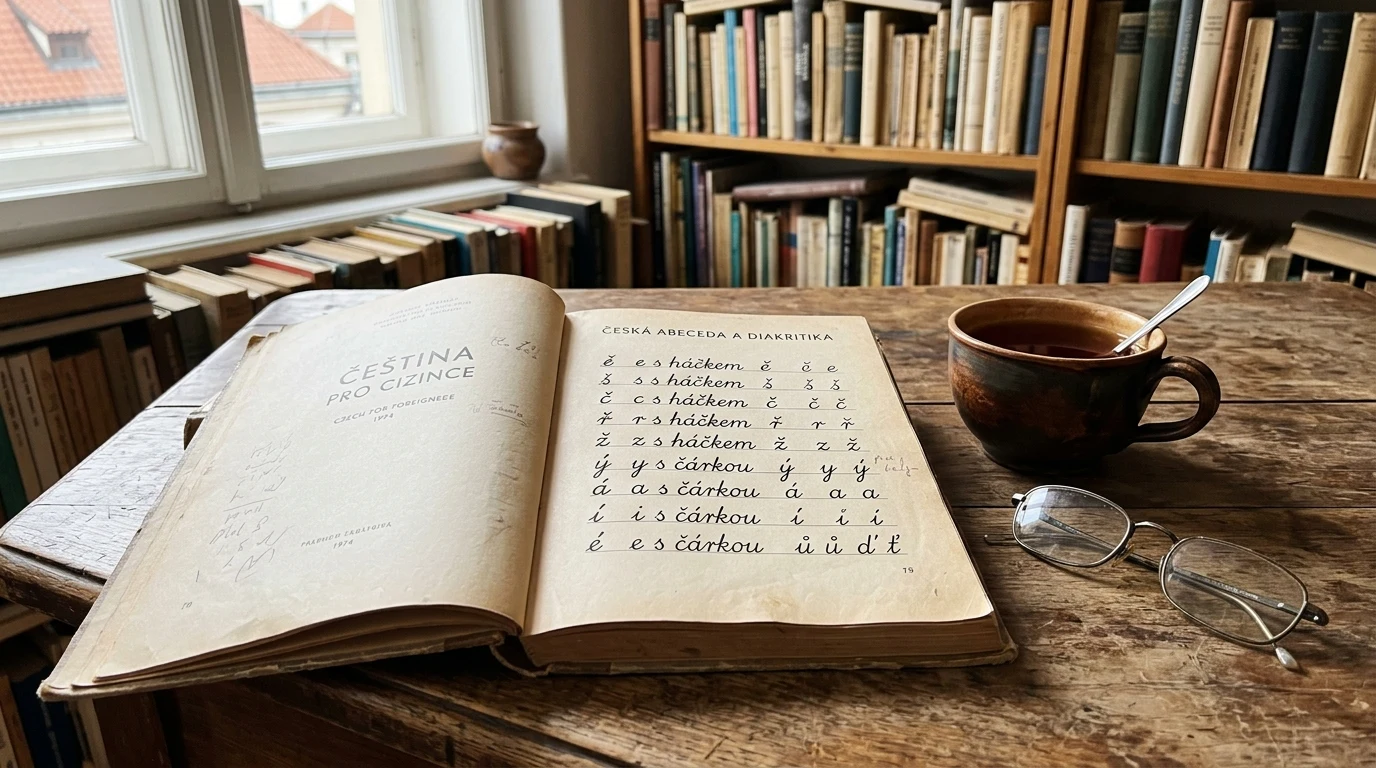
Czech Alphabet: Complete 42-Letter Guide and Pronunciation Chart
✨ This article was AI edited. Editorial responsibility: Magazine of Travel.
The Czech alphabet consists of 42 standardized letters derived from the Latin script, distinguished by unique diacritical marks including the háček (caron), čárka (acute accent), and kroužek (ring). Operating on an almost purely phonetic principle where every character represents a consistent vocal sound, the Czech alphabet includes distinct letters such as Ř, Š, Č, Ž, Ď, Ť, Ň, and the composite digraph CH, with stress universally placed on the first syllable.
For travelers, students, expatriates, and linguaphiles exploring Central Europe, mastering the czech alphabet is the most rewarding gateway to understanding the Czech Republic. While the proliferation of hooks, slashes, and rings over consonants and vowels can appear daunting to English speakers, Czech orthography is remarkably logical, predictable, and systematic. Unlike English—where letters frequently alter pronunciation depending on surrounding vocabulary—the Czech writing system adheres to a consistent phonetic correspondence: once you learn the sounds represented by each of the 42 letters, you can accurately pronounce virtually any Czech word you encounter on street signs, restaurant menus, or train departure boards.
The Structural Architecture of the Czech Alphabet
Modern Czech orthography is based on the system pioneered in the early 15th century by religious reformer Jan Hus in his seminal treatise Orthographia Bohemica. Hus replaced cumbersome digraphs (such as multiple consonants to represent a single sound) with diacritical marks placed above Latin characters. Today, the standardized Czech alphabet recognizes 42 distinct characters, each treated as an individual letter in dictionary cataloging.
To explore how these 42 characters compare to standard Latin and Slavic linguistic matrices, review our foundational analysis on how many letters are in the Czech alphabet and language structure, as well as our linguistic overview on the Czech language and Slavic roots.
Complete 42-Letter Czech Alphabet & Pronunciation Chart
The table below provides the full inventory of all 42 Czech letters in standard alphabetical order, accompanied by their phonetic IPA (International Phonetic Alphabet) symbols, practical English phonetic approximations, and authentic vocabulary examples:
| Letter (Upper / Lower) | Letter Name | IPA Symbol | English Phonetic Equivalent | Czech Example Word & Meaning |
|---|---|---|---|---|
| A a | krátké a | [a] | Like ‘u’ in cup or ‘a’ in father (short) | auto (car) |
| Á á | dlouhé a | [aː] | Like ‘a’ in father, held twice as long | máma (mom) |
| B b | bé | [b] | Like ‘b’ in boat | babička (grandmother) |
| C c | cé | [ts] | Like ‘ts’ in cats or ‘zz’ in pizza | cena (price) |
| Č č | čé | [tʃ] | Like ‘ch’ in church | čaj (tea) |
| D d | dé | [d] | Like ‘d’ in door | den (day) |
| Ď ď | ďé | [ɟ] | Soft ‘d’, like ‘d’ in dew or ‘dg’ in during | ďábel (devil) |
| E e | krátké e | [ɛ] | Like ‘e’ in bed or pen | energie (energy) |
| É é | dlouhé e | [ɛː] | Long ‘eh’, like ‘ai’ in air or ‘ea’ in bear | léto (summer) |
| Ě ě | e s háčkem | [jɛ / ɲɛ] | Pronounced ‘ye’ after most consonants, or softens preceding d, t, n | město (city / town) |
| F f | ef | [f] | Like ‘f’ in friend | film (movie) |
| G g | gé | [ɡ] | Hard ‘g’ as in go (chiefly in loanwords) | galerie (gallery) |
| H h | há | [ɦ] | Voiced ‘h’, deeper than English ‘h’, like ahead | hrad (castle) |
| Ch ch | chá | [x] | Separate letter! Like ‘ch’ in Scottish loch or German Bach | chléb (bread) |
| I i | krátké měkké i | [ɪ] | Like ‘i’ in sit or pin (softens preceding d, t, n) | informace (information) |
| Í í | dlouhé měkké i | [iː] | Like ‘ee’ in seen or meet (held long) | pivo (beer) |
| J j | jé | [j] | Like ‘y’ in yes or yellow | jídlo (food) |
| K k | ká | [k] | Like ‘k’ in kite (unaspirated) | káva (coffee) |
| L l | el | [l] | Like ‘l’ in lamp | láska (love) |
| M m | em | [m] | Like ‘m’ in mother | most (bridge) |
| N n | en | [n] | Like ‘n’ in no | noc (night) |
| Ň ň | eň | [ɲ] | Soft ‘n’, like ‘ny’ in canyon or Spanish ñ | kůň (horse) |
| O o | krátké o | [o] | Like ‘o’ in lot or hot | okno (window) |
| Ó ó | dlouhé o | [oː] | Long ‘aw’, like ‘aw’ in flaw (chiefly in loanwords) | móda (fashion) |
| P p | pé | [p] | Like ‘p’ in park (unaspirated) | pivo (beer) |
| Q q | kvé | [kv] | Used exclusively in foreign loanwords | quiche (quiche) |
| R r | er | [r] | Rolled / trilled ‘r’, tapped against upper palate | řeka (see Ř below) / ryba (fish) |
| Ř ř | eř | [r̝] | The unique Czech sound: simultaneous rolled ‘r’ and ‘zh/sh’ | Řecko (Greece) / tři (three) |
| S s | es | [s] | Like ‘s’ in sun (always unvoiced) | sobota (Saturday) |
| Š š | eš | [ʃ] | Like ‘sh’ in shoe or ship | škola (school) |
| T t | té | [t] | Like ‘t’ in table | tramvaj (tram) |
| Ť ť | ťé | [c] | Soft ‘t’, like ‘t’ in British tune or ‘ch’ in nature | chuť (taste / appetite) |
| U u | krátké u | [u] | Like ‘u’ in put or ‘oo’ in book | ulice (street) |
| Ú ú | dlouhé u s čárkou | [uː] | Long ‘oo’ like moon; used at the beginning of words | úterý (Tuesday) |
| Ů ů | ů s kroužkem | [uː] | Identical sound to Ú ([uː]), used inside or at end of words | stůl (table) |
| V v | vé | [v] | Like ‘v’ in voice | voda (water) |
| W w | dvojité vé | [v] | Identical sound to V; used in loanwords and names | wellness (spa) |
| X x | iks | [ks] | Like ‘x’ in taxi; used in loanwords | praxe (practice) |
| Y y | krátké tvrdé y | [ɪ] | Identical sound to I ([ɪ]), but keeps preceding consonant hard | syn (son) |
| Ý ý | dlouhé tvrdé y | [iː] | Identical sound to Í ([iː]), held long | býk (bull) |
| Z z | zet | [z] | Like ‘z’ in zoo | zahrada (garden) |
| Ž ž | žet | [ʒ] | Like ‘s’ in measure, ‘g’ in genre, or French je | žena (woman) |
The Three Vital Diacritical Marks
Diacritics are not decorative embellishments in Czech; they change the lexical meaning and grammatical case of words entirely. For example, pas means “passport,” whereas pás means “belt” or “zone.” There are three core diacritical signs:
1. Háček ( ˇ ) — The Little Hook
The háček transforms hard consonants into soft, palatalized equivalents (Č, Š, Ž, Ď, Ť, Ň) and creates the unique voiced alveolar non-sonorant trill in Ř. When applied to lowercase d and t, it transforms into an apostrophe-like stroke: ď and ť. Over ě, it indicates palatalization of the preceding consonant.
2. Čárka ( ´ ) — The Acute Accent
The čárka denotes vowel length. In Czech, long vowels (Á, É, Í, Ó, Ú, Ý) are held roughly twice as long as short vowels, without altering the underlying tongue placement or vowel quality. Vowel length in Czech is completely independent of word stress.
3. Kroužek ( ˚ ) — The Ring
The kroužek appears exclusively over the letter ů. Historically, Old Czech pronounced this sound as a diphthong [uo]. Over centuries, the pronunciation merged completely with long [uː] (identical to ú). Orthographic convention dictates that ú is written at the beginning of words (e.g., úkol – task), while ů is used inside roots or suffixes (e.g., dům – house, domů – homeward).
The Infamous Czech “Ř” and Syllabic Consonants
No discussion of the Czech alphabet is complete without the formidable Ř (lower case ř). Known phonetically as a raised alveolar trill ([r̝]), it is virtually unique to the Czech language. It requires vibrating the tongue against the alveolar ridge while simultaneously forcing air through a narrow channel to create a fricative buzzing sound akin to pronouncing “r” and “zh” at the exact same instant.
Additionally, Czech consonants R and L can function as syllabic nuclei, meaning words can be formed without any vowels whatsoever. This phenomenon produces famous Czech tongue twisters such as:
“Strč prst skrz krk” (Stick a finger through your neck!)
In such words, the rolled ‘r’ or ‘l’ carries the beat of the syllable just like a traditional vowel would.
Stress and Intonation: The First Syllable Rule
One of the most welcoming rules for learners of Czech is that word stress is always fixed on the first syllable of a word or prepositional phrase. Regardless of word length, whether a word contains short or long vowels, or how many diacritics appear later in the word, primary acoustic stress consistently strikes syllable number one (e.g., PRA-ha, CES-ta, NE-pře-mýš-le-li).
To learn more about everyday communication and practical speaking tips in the capital city, check out our guide on what language is spoken in Prague and tourist centers.
Frequently Asked Questions About the Czech Alphabet
How many letters are in the Czech alphabet?
The official Czech alphabet contains 42 letters. This includes all 26 basic Latin letters plus characters modified with diacritics (such as Á, Č, Ď, É, Ě, Í, Ň, Ó, Ř, Š, Ť, Ú, Ů, Ý, Ž) and the unique composite digraph CH, which is cataloged as its own distinct letter between H and I.
What is the most difficult letter to pronounce in Czech?
The letter Ř (ř) is widely considered the most challenging sound for non-native speakers. It is a voiced alveolar trilled fricative produced by simultaneously rolling the tongue like an ‘r’ while expelling air like a ‘zh’ sound.
Why are there two different ‘u’ letters (Ú and Ů) in Czech?
Both Ú and Ů represent the exact same long vowel sound [uː]. The difference is purely historical and orthographic: Ú is used at the beginning of words (e.g., úterý – Tuesday), while Ů (with the ring / kroužek) is used in the middle or end of words (e.g., stůl – table) where an Old Czech diphthong [uo] once existed.
Where is the accent/stress placed in Czech words?
In Czech, the stress is always placed on the very first syllable of the word. Accent marks (čárky) over vowels do not indicate stress; they indicate vowel duration (how long the vowel sound is held).
Získejte naše nejnovější články, návody a tipy přednostně ve vyhledávání Google a v AI přehledech.


