
Budapest Ruin Bars Guide: History, Best Locations & Nightlife Etiquette
The ultimate insider guide to Budapest’s ruin bars in District VII. Discover Szimpla Kert, Instant-Fogas, secret courtyards, signature drinks, and nightlife safety.
Budapest is a Central European nation situated in the Pannonian Basin and bisected by the Danube River, distinguished by its unique Finno-Ugric cultural identity, world-renowned natural thermal spa traditions, and grand architectural heritage centered upon its capital, Budapest.
Comparing medicinal hot spring mineral compositions, Ottoman domes, outdoor wave pools, and bathing etiquette.
Exploring District VII’s historic Jewish Quarter, art courtyards, Szimpla Kert, and evening nightlife etiquette.
Direct Metropolitan train route following the Danube river bend into Budapest Nyugati station.
Budgeting in Hungarian Forints, card acceptance, and avoiding dynamic conversion at Hungarian ATMs.
Budapest occupies the central Carpathian basin, defined by the northward-to-southward transit of the Danube (Duna) and Tisza rivers. Geologically, Budapest sits atop one of the earth’s thinnest continental crusts, creating an abundance of natural geothermal springs that have shaped local culture for over two millennia—beginning with Roman settlements at Aquincum, expanding under 16th-century Ottoman Turkish rule, and culminating in the grand Fin-de-Siècle spa palaces of the late Austro-Hungarian Empire.
Budapest is a member of the European Union and the Schengen Area, but retains its sovereign currency, the Hungarian Forint (HUF). Due to currency denomination scale, travelers must exercise attentiveness with paper banknotes (ranging from 500 to 20,000 Forints) and verify that point-of-sale card readers process transactions in HUF rather than home currencies.
Railway transit is managed by Hungarian State Railways (MÁV-START), operating out of three primary Budapest termini: Keleti (Eastern), Nyugati (Western), and Déli (Southern). International EuroCity trains connect Budapest directly with Vienna (under 2.5 hours via Railjet), Bratislava (2 hrs 25 min), and Prague (under 7 hours), providing straightforward overland links.
| Hungarian Region | Primary Centers | Signature Highlights | Regional Flavors & Gastronomy |
|---|---|---|---|
| Budapest Metropolitan | Buda & Pest districts | Parliament, Fisherman’s Bastion, Széchenyi Baths, Ruin Bars | Gulyásleves (goulash), lángos, chimney cake (kürtőskalács) |
| Danube Bend (Dunakanyar) | Szentendre, Visegrád, Esztergom | Medieval citadel ramparts, Esztergom Basilica, artists’ colony | Halászlé (fishermen’s soup), river trout |
| Lake Balaton | Siófok, Balatonfüred, Tihany | Central Europe’s largest freshwater lake, sailing, volcanic hills | Badacsony volcanic white wines (Olaszrizling) |
| Tokaj Wine Region | Tokaj, Mád, Sárospatak | UNESCO historic wine cellars, sweet botrytized Aszú wines | Tokaji Aszú, Furmint wine pairings |
Budapest uses the Hungarian Forint (HUF). While select international hotels and restaurants in central Budapest accept Euros, exchange rates are unfavorable with change returned in Forints. Paying by card in HUF is strongly advised.
Bring a swimsuit, flip-flops or slippers (mandatory on wet floors), and a towel. A swimming cap is required if utilizing lane swimming pools (such as the main pool at Széchenyi or Gellért), though thermal soaking pools do not require caps.

The ultimate insider guide to Budapest’s ruin bars in District VII. Discover Szimpla Kert, Instant-Fogas, secret courtyards, signature drinks, and nightlife safety.
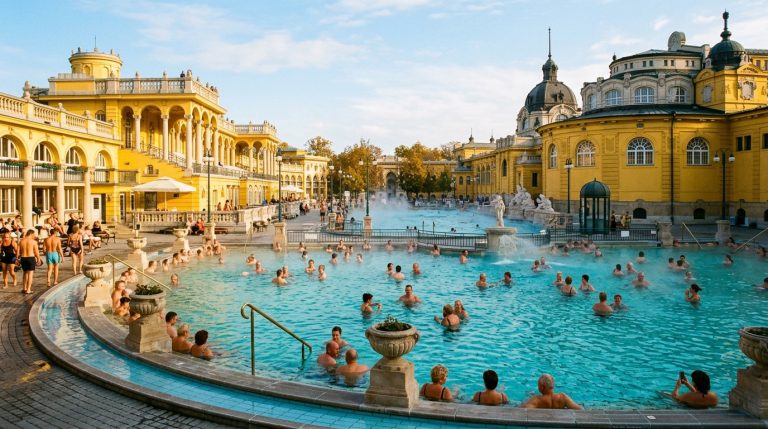
Compare Budapest’s top thermal baths: Széchenyi, Gellért, and Rudas. Explore mineral pool temperatures, architecture, ticket costs, etiquette, and packing tips.