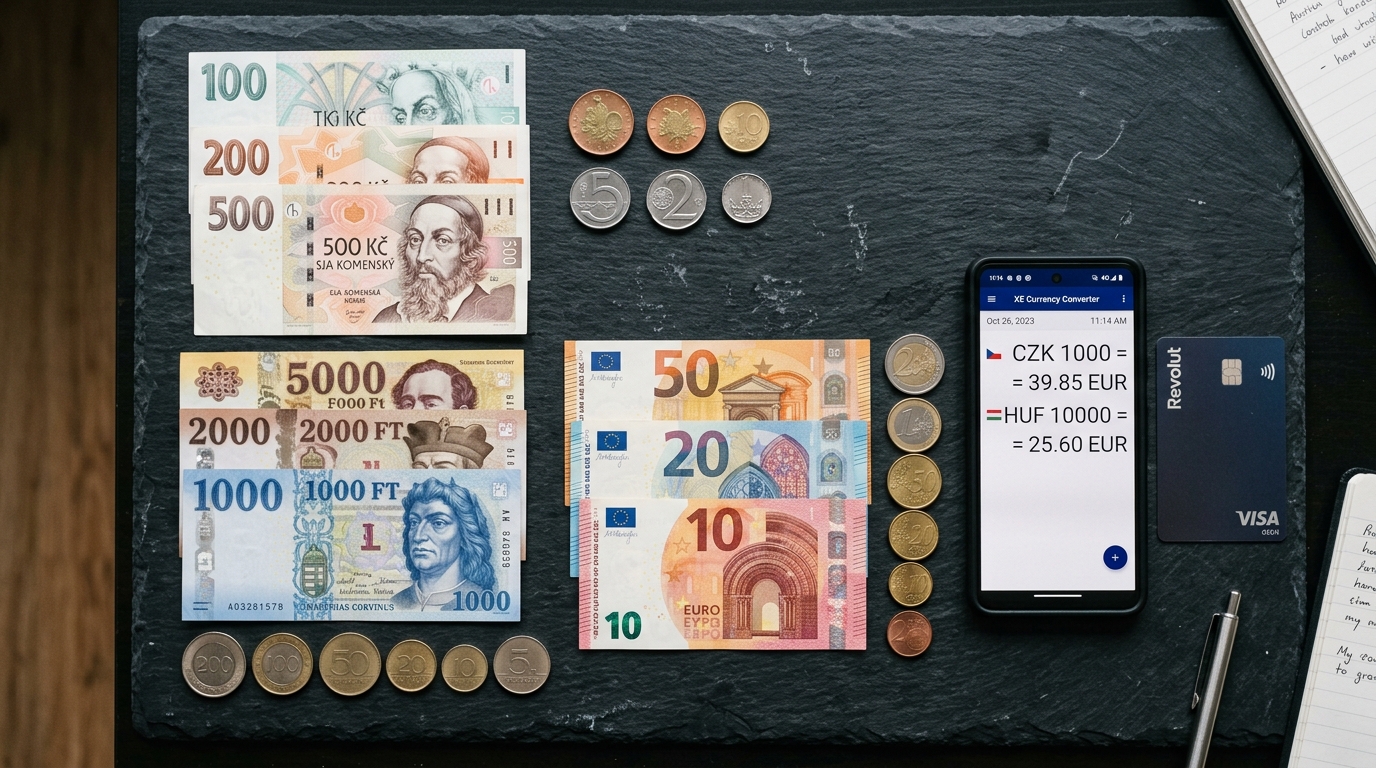
Central European Currency Guide: Navigating CZK, HUF, and EUR on One Multi-City Trip
✨ This article was AI edited. Editorial responsibility: Magazine of Travel.
One of the most frequent surprises for first-time visitors traveling the classic Prague–Vienna–Bratislava–Budapest circuit is that Central Europe is not a single currency zone. Across four neighboring capitals connected by short two-hour train hops, you will navigate three distinct monetary regimes: the Czech Koruna (CZK), the Euro (EUR), and the Hungarian Forint (HUF). Here is your battle-tested financial guide to beating dynamic currency conversion traps, identifying predatory ATMs, and minimizing transaction fees across borders.
Overview: The Central European Tri-Currency Matrix
Before boarding your first cross-border train, understand the monetary landscape of each country along your route:
| Country & Capital | Official Currency | Symbol & ISO Code | Approximate Benchmark | Card Acceptance Level |
|---|---|---|---|---|
| Czech Republic (Prague) | Czech Koruna | Kč / CZK | 1 EUR ≈ 25.20 CZK | 1 USD ≈ 23.40 CZK | Very High (95%+) |
| Austria (Vienna) | Euro | € / EUR | Official Eurozone currency | Moderate–High (Some cafes prefer cash) |
| Slovakia (Bratislava) | Euro | € / EUR | Official Eurozone currency (Since 2009) | Very High (95%+) |
| Hungary (Budapest) | Hungarian Forint | Ft / HUF | 1 EUR ≈ 395–405 HUF | 1 USD ≈ 370 HUF | Very High (95%+) |
Can You Pay in Euros in Prague and Budapest?
This is the single most common question from international travelers: “Can I just carry Euros and skip exchanging Koruna and Forint?”
The answer is: You physically can in some tourist zones, but you definitely should not.
- The Merchant Exchange Penalty: When a restaurant or souvenir shop in Prague or Budapest accepts Euros, they set their own arbitrary internal conversion rate. A meal costing 500 CZK (€20 at real market rates) will routinely be billed as €24 to €26 in cash.
- Change Returned in Local Currency: If you hand over a €50 bill for a €20 purchase in Prague, the merchant will almost invariably calculate the exchange at an unfavorable spread and give you the change in Czech Koruna.
- The Golden Rule: Always pay in the local legal tender of the country, or pay with a zero-fee contactless credit/debit card.
The #1 Financial Trap: Dynamic Currency Conversion (DCC)
Whether withdrawing cash from an ATM or tapping your card at a supermarket in Prague or Budapest, payment screens will present a deceptive prompt:
“Would you like to be charged in your home currency (USD / GBP / EUR)?”
This feature is called Dynamic Currency Conversion (DCC). It is designed to profit from travelers’ desire for familiar numbers:
- If you select “Yes (Charge in USD/GBP)”: The local terminal handles the conversion, applying an aggressive hidden foreign exchange markup ranging between 6% and 14% above interbank rates.
- If you select “No / Decline Conversion (Charge in CZK / HUF)”: Your own domestic bank or card issuer (e.g., Chase, Revolut, Monzo, Wise) converts the transaction at standard wholesale interbank rates, saving you substantial money.
- Always press “DECLINE CONVERSION” or “CONTINUE WITHOUT CONVERSION”.
How to Identify and Avoid Predatory ATMs
Tourist corridors in Prague (Old Town Square, Karlova street), Vienna (Kärntner Straße), and Budapest (Váci utca) are saturated with standalone, yellow-and-blue Euronet ATMs.
Why Euronet ATMs should be avoided:
- They charge substantial operator access fees (€4.00 to €8.00 per withdrawal).
- They push default cash withdrawal prompts for massive sums (e.g., prompting 10,000 CZK / €400 as the minimum quick-pick option).
- They force confusing, multi-step DCC prompts designed to trick users into accepting 12% exchange margins.
Always use official retail commercial bank ATMs attached to physical bank branches:
- In Czech Republic: Česká spořitelna (Erste), ČSOB, Komerční banka (KB), Air Bank.
- In Austria: Erste Bank / Sparkasse, Bank Austria, Raiffeisenlandesbank.
- In Slovakia: Slovenská sporiteľňa, VÚB Banka, Tatra banka. (See our Slovakia costs guide).
- In Hungary: OTP Bank, Erste Bank, K&H Bank, Raiffeisen Bank.
How Much Physical Cash Do You Actually Need?
Thanks to widespread contactless infrastructure across Central Europe, you need very little physical paper money:
- Prague: 500 to 1,000 CZK (approx. €20–€40) for public restroom entry turnstiles, craft beer stalls at Náplavka riverbank, or tips at small traditional pubs.
- Vienna & Bratislava: €30 to €50 in Euro cash. While Bratislava is near-total digital payment, some traditional Viennese coffeehouses and sausage stands (Würstelstände) still maintain cash-only rules.
- Budapest: 8,000 to 12,000 HUF (approx. €20–€30) for vintage flea markets (Ecseri), local thermal bath locker deposits, and market halls.
Digital Multi-Currency Tools: Wise and Revolut
For seamless transit across multiple currency borders, carrying a multi-currency travel debit card like Revolut or Wise eliminates foreign exchange headaches:
- You can open sub-accounts in CZK, HUF, and EUR within the same mobile app.
- The card automatically detects which country you are transacting in and debits the appropriate local currency balance with zero conversion markup during market hours.
- Contactless smartphone wallets (Apple Pay and Google Pay) function identically across all transit turnstiles and store terminals throughout the four capitals.
Frequently Asked Questions About Central European Currencies
Can I use Czech Koruna in Slovakia?
No. Although the Czech Republic and Slovakia were united as Czechoslovakia until the peaceful Velvet Divorce of 1993, Slovakia adopted the Euro in 2009. Czech Koruna is not accepted in Slovak stores or restaurants.
What happens if I have leftover Hungarian Forint or Czech Koruna?
Coinage cannot be exchanged once you leave the country, so spend your coins on transit snacks or coffee before boarding your outbound train. Paper banknotes can be exchanged at airport exchange kiosks or deposited back into multi-currency accounts.
Do public restrooms in Central Europe accept credit cards?
Major railway stations (such as Wien Hbf, Praha hlavní nádraží, and Budapest-Nyugati) feature automated toilet turnstiles (Rail & Fresh) that accept contactless credit cards and Apple Pay (€0.50 to €1.00 fee). However, secondary stations and city parks often require exact coins.
Is tipping in Euros accepted in Prague and Budapest restaurants?
If paying your bill by credit card in local currency, you can either round up the total on the card terminal or leave a tip in Euro cash (€1 to €2 coins), which servers appreciate.
How can I track my spending across three currencies on a single trip?
Download an offline currency converter app like XE Currency or Forex before traveling. Setting up home currency benchmarks (e.g., knowing that 100 CZK is roughly $4.30 and 1,000 HUF is roughly $2.70) helps you immediately gauge menu prices without mental math fatigue.
Získejte naše nejnovější články, návody a tipy přednostně ve vyhledávání Google a v AI přehledech.