Vienna Coffeehouse Culture: Historic Etiquette, What to Order & Top 7 Cafes
✨ This article was AI edited. Editorial responsibility: Magazine of Travel.
In Vienna, a coffeehouse is not merely a place to consume caffeine—it is an extended living room, a public literary salon, and a recognized institution inscribed on the UNESCO Intangible Cultural Heritage list. Here, time is measured not in billable table turnover, but in broadsheet newspapers read and hours spent in contemplation over marble tabletops. Understanding the nuances of Viennese coffeehouse culture (Wiener Kaffeehauskultur) unlocks one of the most refined urban traditions in the world.
What Are the Essential Viennese Coffee Specialties and How Do You Order?
Never enter a traditional Viennese cafe and ask for a generic “regular coffee.” Viennese coffee terminology has developed its own precise lexicon over three centuries:
| Coffee Specialty | Composition & Preparation | Glass / Cup Type | Typical Price |
|---|---|---|---|
| Wiener Melange | Half mild espresso, half steamed milk, topped with rich milk foam | Large porcelain cup | €5.40 – €6.50 |
| Einspänner | Double espresso topped with a thick layer of cold whipped cream (Schlagobers) | Handled glass | €5.80 – €6.90 |
| Kleiner / Großer Brauner | Single or double espresso served with a tiny pitcher of coffee cream | Small or medium cup | €4.20 / €5.80 |
| Verlängerter | Espresso diluted with an equal portion of hot water (black or brown with cream) | Medium cup | €4.80 – €5.60 |
| Franziskaner | Melange topped with whipped cream instead of milk foam | Large cup | €5.90 – €6.80 |
The Ritual of the Silver Tray and the Glass of Water
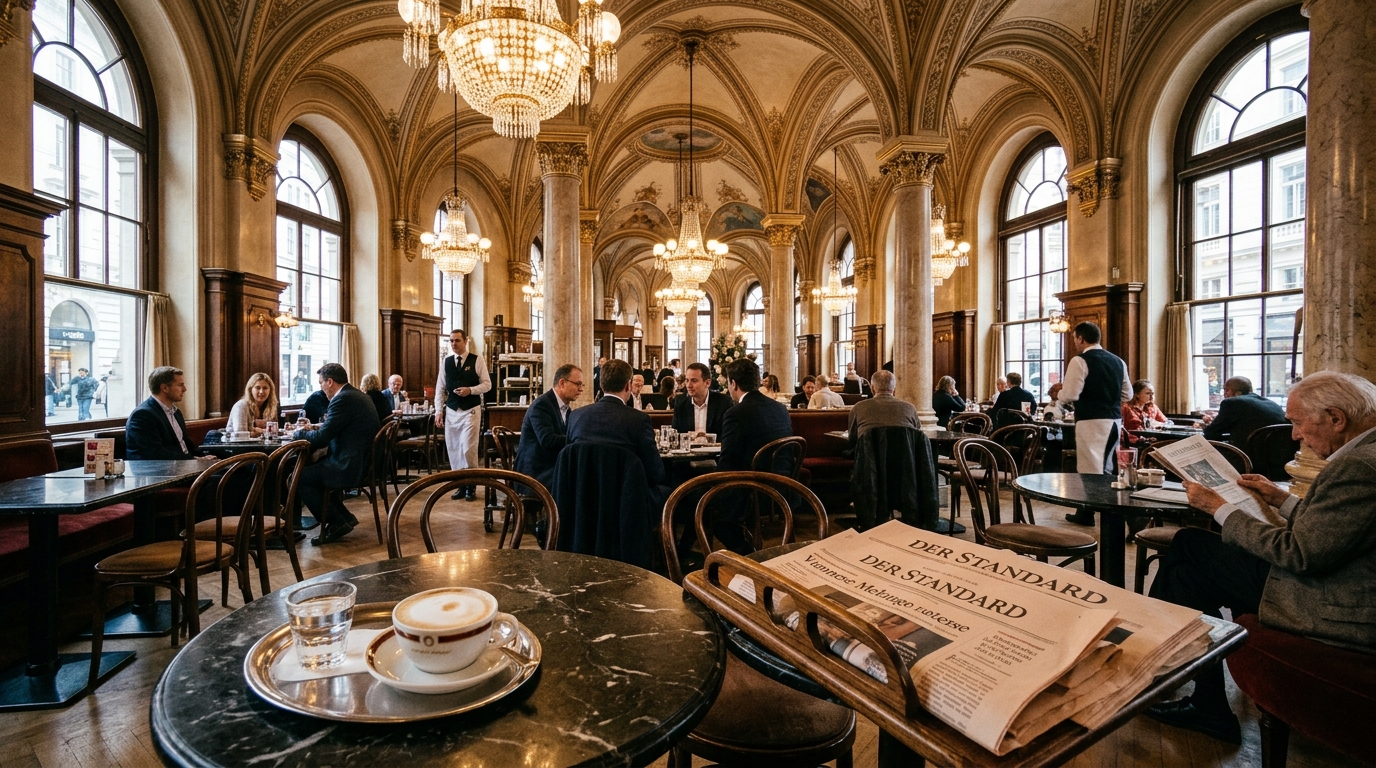
Whenever your order arrives, it will invariably be presented on an oval silver-plated tray containing:
- Your ordered coffee cup.
- Wrapped sugar cubes or paper packets.
- A small glass of cold, crystal-clear tap water.
- A coffee spoon placed face-down balanced directly across the top rim of the water glass.
This presentation is a hallmark of Viennese hospitality dating to the 19th century. Vienna’s tap water is mountain spring water piped directly from the Styrian Alps via high-gradient aqueducts. The inverted spoon originally served to prove to the guest that the water glass was fresh and had not been previously used. Sip the water between tastes of coffee to cleanse the palate.
The Top 5 Historic Coffeehouses in Vienna
1. Café Central (Herrengasse 14)
Opened in 1876 in the Palais Ferstel, Café Central was the intellectual epicenter of Central Europe. Key patrons included Leon Trotsky, Sigmund Freud, and poet Peter Altenberg (whose papier-mâché statue greets visitors at the entrance). Its soaring Gothic-revival vaulted ceilings and grand piano performances make it Vienna’s most famous venue. Expect queue times of 20 to 35 minutes during peak afternoon hours.
2. Café Sperl (Gumpendorfer Straße 11)
Preserved virtually unchanged since 1880, Sperl retains its authentic parquetry flooring, velvet-upholstered booths, and operational carom billiard tables. It offers a quieter, more local atmosphere than the inner-city flagship cafes.
3. Café Landtmann (Universitätsring 4)
Established in 1873 along the Ringstraße, Landtmann was Sigmund Freud’s preferred cafe and remains a primary meeting ground for Austrian politicians, journalists, and actors from the adjacent Burgtheater.
4. Café Hawelka (Dorotheergasse 6)
Dark, intimate, and steeped in post-war bohemian history, Hawelka was run by Leopold and Josefine Hawelka. Famous for its warm Buchteln (yeast buns filled with plum jam) served fresh out of the oven every evening after 20:00.
5. Café Sacher (Philharmoniker Straße 4)
Located opposite the Vienna State Opera, this opulent salon is the home of the official, trademarked Original Sacher-Torte, created by Franz Sacher in 1832. It features dense chocolate sponge, tart apricot jam layers, and dark chocolate icing, served with unsweetened whipped cream.
Viennese Coffeehouse Etiquette Rules
- Table Selection: In traditional cafes without a podium host, you may seat yourself wherever an open table is available.
- Unrushed Residency: Once you purchase a coffee, you have legal permission to remain at your table for hours. Waiters will never present the bill unprompted or rush you out.
- The Newspaper Sticks (Zeitungshalter): Wooden poles holding local broadsheets (Der Standard, Die Presse) and international dailies hang on wall racks. You are welcome to browse them freely.
- Addressing the Waiter: The head waiter in formal tuxedo attire is traditionally called “Herr Ober”. To ask for the bill, make brief eye contact and say “Zahlen, bitte” (Pay, please).
- Tipping: Round up the bill by 5% to 10% (e.g., round €13.20 to €15.00).
Connecting Vienna to the Golden Triangle
Vienna’s coffeehouse culture directly influenced cafe institutions across the former Austro-Hungarian territories:
- Plan a visit to the imperial Habsburg summer estate with our Schönbrunn Palace visitor guide.
- Take a scenic morning boat trip down the Danube into Slovakia via our Vienna to Bratislava Twin City Liner guide.
- Or board the hourly commuter train with our Vienna to Bratislava train schedule.
Frequently Asked Questions About Viennese Coffeehouses
Can you sit in a Viennese coffeehouse with a laptop?
While some modern cafes welcome remote workers, traditional historic coffeehouses (such as Café Sperl or Café Prückel) discourage laptops or ban them during peak afternoon hours to preserve the conversational reading atmosphere.
Do Viennese cafes accept credit cards?
Most major tourist cafes accept cards, but several revered historic establishments remain strictly cash-only or require minimum amounts. Always carry €20 to €30 in Euro cash.
What is the difference between a Cappuccino and a Melange?
A traditional cappuccino uses strong espresso and steamed milk, often topped with cocoa powder. A Wiener Melange uses a milder, lighter espresso roast with half milk and half foam, and is never dusted with cocoa in authentic cafes.
Are reservations necessary?
Most historic cafes operate on a first-come, first-served walk-in basis. Café Central and Café Landtmann accept online table reservations for breakfast and lunch.
What pastry pairs best with Viennese coffee?
The classic pairings are warm Wiener Apfelstrudel (Viennese apple strudel with raisins and cinnamon), Topfenstrudel (sweet curd cheese strudel), or the rich apricot-layered Sachertorte.
Získejte naše nejnovější články, návody a tipy přednostně ve vyhledávání Google a v AI přehledech.