Tschechien Grenzgebiet: Czech Border Region Travel Guide | Magazine of Travel
✨ This article was AI edited. Editorial responsibility: Magazine of Travel.
The Czech border region (Tschechien Grenzgebiet): Encompassing the mountainous frontier encircling Bohemia and Moravia along the borders of Germany (Saxony, Bavaria), Austria, Poland, and Slovakia, the Czech borderlands represent one of Central Europe’s most captivating travel corridors. Featuring dramatic national parks such as Bohemian Switzerland (České Švýcarsko), the Ore Mountains (Krušné hory), and the Šumava National Park, the Tschechien Grenzgebiet offers cross-border hiking, UNESCO spa towns, accessible shopping, and pristine wilderness connected by seamless Schengen transit.
What is the Tschechien Grenzgebiet? Geography and Frontier Heritage
The German term Tschechien Grenzgebiet refers broadly to the borderlands of the Czech Republic, with particular emphasis on the expansive, 815-kilometer western and northern perimeter shared with the Federal Republic of Germany (specifically the German federal states of Saxony and Bavaria). Geographically, the Czech border is unique in Europe: Bohemia is virtually surrounded by natural mountain ramparts—the Bohemian Forest (Šumava) to the southwest, the Ore Mountains (Krušné hory / Erzgebirge) to the northwest, the Lusatian and Jizera Mountains to the north, and the Giant Mountains (Krkonoše) to the northeast.
Historically known as the Sudeten borderlands, these territories witnessed centuries of intensive German-Czech cultural, architectural, and industrial intermingling. Today, as fellow members of the European Union and the passport-free Schengen Area, the Czech-German border represents an open, highly integrated regional corridor where travelers, hikers, cyclists, and weekend day-trippers transition between countries effortlessly.
| Border Sector | Adjacent German State | Key Gateway Towns (Czech / German) | Top Natural & Cultural Highlights |
|---|---|---|---|
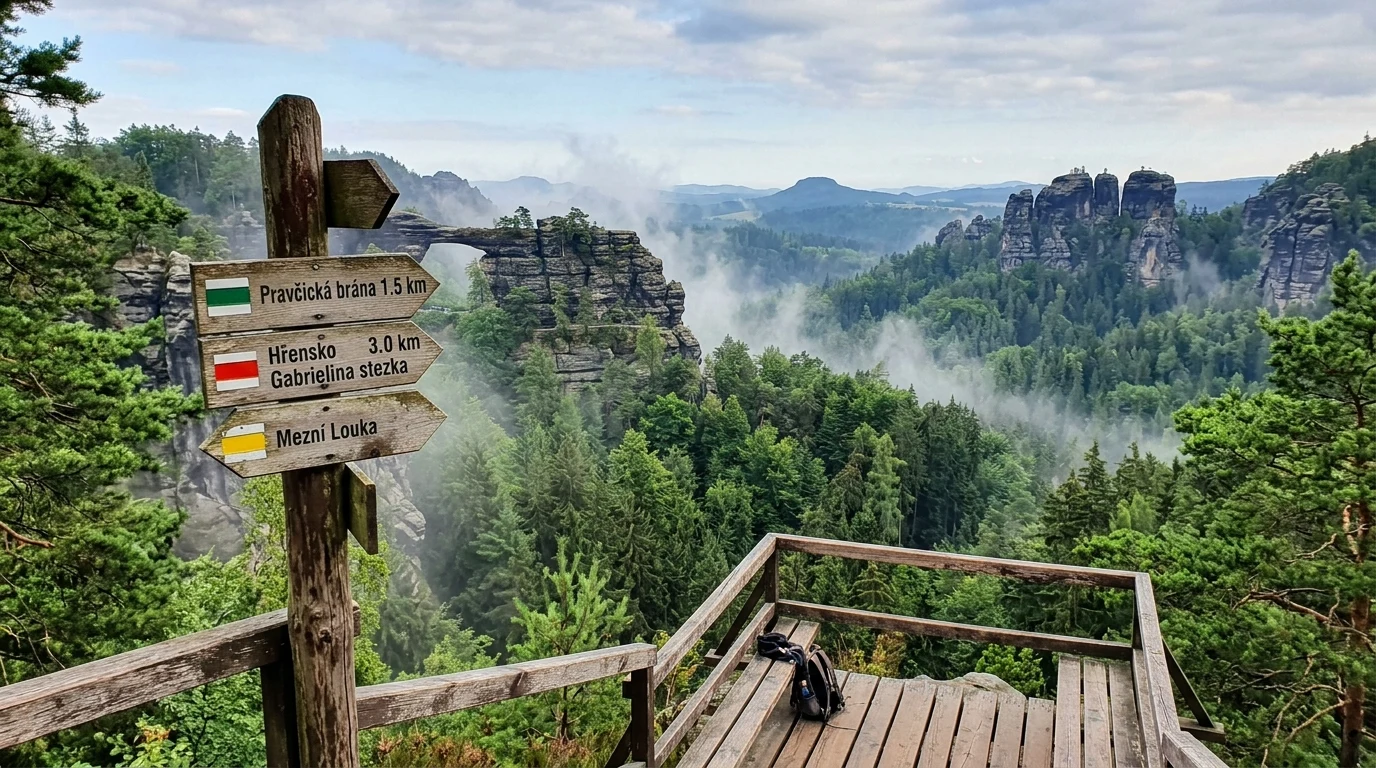
| Bohemian Switzerland | Saxony (Sachsen) | Hřensko, Děčín / Bad Schandau, Pirna | Pravčická brána, Kamenice Gorges, Elbe Canyon sandstone towers |
| Ore Mountains (Krušné hory) | Saxony (Sachsen) | Boží Dar, Jáchymov / Oberwiesenthal, Annaberg | UNESCO mining landscapes, Klínovec ski resort, thermal radon spas |
| West Bohemian Spa Triangle | Bavaria (Bayern) | Cheb, Františkovy Lázně / Waldsassen, Schirnding | Romanesque Cheb Castle, mineral spring colonnades, peat bogs (Soos) |
| Bohemian Forest (Šumava) | Bavaria (Bayern) | Železná Ruda, Prášily / Bayerisch Eisenstein, Zwiesel | Černé jezero (Black Lake), primeval beech forests, Vltava river source |
| South Bohemian Borderland | Upper Austria (Oberösterreich) | Vyšší Brod, Lipno nad Vltavou / Bad Leonfelden | Lipno Reservoir water sports, Cistercian Monastery, Schwarzenberg Canal |
Key Geographic Sectors along the German-Czech Border
1. Saxon-Bohemian Switzerland (Elbe Sandstone Mountains)
Located barely two hours south of Berlin and just 90 minutes north of Prague, the transboundary national park region comprising Bohemian Switzerland (Národní park České Švýcarsko) on the Czech side and Saxon Switzerland (Nationalpark Sächsische Schweiz) on the German side is globally famous for its colossal sandstone rock towers, labyrinthine canyons, and dense pine forests carved by the Elbe River (Labe).
- Pravčická brána (Prebischtor): The defining geological icon of the region and the largest natural sandstone rock arch in continental Europe, spanning 26.5 meters across a towering gorge. Adjacent sits Sokolí hnízdo (Falcon’s Nest), an exquisite 19th-century alpine chateau built into the sandstone cliffs by Prince Edmund of Clary-Aldringen.
- Edmund and Wild Gorges (Edmundova a Divoká soutěska): Dramatic river canyons near the border village of Hřensko where visitors traverse narrow sandstone chasms aboard traditional wooden punting boats guided by local ferrymen.
- Cross-Border Hiking: The Malerweg (Painter’s Way) trail on the German side connects seamlessly via historic border footpaths to the Czech Gabriela’s Trail (Gabrielina stezka), enabling multi-day wilderness backpacking without vehicular transit.
2. The Ore Mountains (Krušné hory / Erzgebirge)
Inscribed on the UNESCO World Heritage List in 2019 as the Erzgebirge/Krušnohoří Mining Region, this 150-kilometer-long mountain ridge was Europe’s primary metallurgical crucible for over eight centuries, producing silver, tin, cobalt, and uranium. The historic silver minted in the border valley of Jáchymov (St. Joachimsthal) gave birth to the Joachimsthaler coin, the direct etymological ancestor of the world’s most ubiquitous currency name: the dollar.
- Klínovec and Fichtelberg: The twin peaks of Klínovec (1,244 m, Czechia) and Fichtelberg (1,215 m, Germany) form the premier winter sports and mountain biking destination in northern Central Europe. A unified cross-border lift ticket allows skiers to navigate between both countries on interconnected slopes.
- Jáchymov Spa (Lázně Jáchymov): The world’s first radon spa resort, founded in 1906, harnessing mineral-rich thermal waters extracted from the deepest working uranium mine in Europe (Svornost Mine) to treat musculoskeletal disorders.
- Boží Dar Peat Bogs: The highest-altitude town in Central Europe (1,028 m above sea level), encircled by ancient subalpine peat bogs traversed by wooden educational boardwalks accessible year-round.
3. The Bohemian Forest (Šumava) & Bavarian Forest (Bayerischer Wald)
Known affectionately as the “Green Roof of Europe,” the contiguous forest expanse of Šumava National Park and the Bavarian Forest National Park constitutes the largest continuous protected wilderness area in Central Europe. Isolated for over four decades by the fortified fences of the Cold War Iron Curtain, nature regenerated with astonishing vigor, creating sanctuaries for elusive wildlife including the Eurasian lynx, grey wolf, European otter, and capercaillie.
- Glacial Lakes: Nestled beneath steep granite cliffs, glacial lakes like Černé jezero (Black Lake) and Čertovo jezero (Devil’s Lake) near the border hub of Železná Ruda showcase untouched primeval alpine waters.
- Bayerisch Eisenstein / Železná Ruda-Alžbětín Train Station: A striking monument to European integration: the international border line slices directly through the center of the historic 1877 railway station building and platform. Half the station is maintained by Deutsche Bahn, the other half by České dráhy.
- The Schwarzenberg Timber Floating Canal: A marvel of 18th-century hydraulic engineering designed by Josef Rosenauer, transporting timber through mountain tunnels across the continental divide between the Vltava (North Sea basin) and the Danube (Black Sea basin).
4. The West Bohemian Spa Triangle
Adjacent to the Upper Franconian and Upper Palatinate regions of Bavaria sits the storied West Bohemian Spa Triangle, comprising Karlovy Vary (Karlsbad), Mariánské Lázně (Marienbad), and Františkovy Lázně (Franzensbad), inscribed by UNESCO as part of the “Great Spa Towns of Europe”:
- Cheb (Eger): A historic crossroads city featuring the Romanesque Cheb Castle with its rare 12th-century Hohenstaufen Black Tower and double chapel, alongside the picturesque Špalíček—a cluster of eleven Gothic-timbered merchant houses on the main square.
- Soos National Nature Reserve: Situated just north of Františkovy Lázně, this vast mineral peat bog features bubbling mofettes (CO2 mud vents) and rare halophytic salt-marsh plants, creating an eerie, primordial moonscape.
Practical Cross-Border Travel & Transit Regulations
Schengen Border Formalities
Since the Czech Republic joined the Schengen Area in December 2007, permanent fixed border checkpoints between Germany, Austria, Poland, and Czechia have been dismantled. Vehicles, cyclists, and pedestrians cross without stopping. However, travelers must observe crucial regulatory stipulations:
- Mandatory Identification: You must carry a valid national ID card (for EU/EEA citizens) or a valid international passport (for non-EU citizens). Random mobile customs controls (Zoll / Celní správa) are legally conducted within a 30-kilometer depth zone along either side of the border.
- Driving Regulations & Motorway Vignettes: While driving on secondary roads and local border routes is completely toll-free, driving on Czech motorways (designated by the letter “D”, such as the D8 from Dresden/Prague or D5 from Nuremberg/Pilsen) requires an electronic motorway vignette (elektronická dálniční známka). Vignettes must be purchased online at the official state portal (edalnice.cz) prior to entering highway sectors. The 10-day vignette costs approximately 270 CZK (€11). Cameras over motorways automatically scan license plates; driving without a registered vignette incurs fines up to 5,000 CZK (€200).
- Speed Limits & Road Rules: In the Czech Republic, the blood-alcohol limit for drivers is 0.00‰ (strict zero tolerance). Daytime running lights must be illuminated at all times year-round. Maximum speeds are 50 km/h in urban areas, 90 km/h on country roads, and 130 km/h on motorways.
Public Transit & Cross-Border Train Connections
The Czech Republic and Germany operate deeply integrated regional rail corridors:
- EuroCity Trains (Berliner / Vindobona): Connect Hamburg, Berlin, and Dresden directly to Prague via Bad Schandau and Děčín along the picturesque Elbe Valley line every two hours.
- Regional Cross-Border Rail Passes: The Elbe-Labe Ticket permits unlimited daily travel on trains, buses, and ferries throughout both the Saxon and Bohemian Switzerland regions for a modest flat fee. Similar regional tickets exist for the EgroNet network spanning Bavaria, Saxony, Thuringia, and West Bohemia.
Shopping, Gastronomy, and Practical Economics in the Grenzgebiet
For decades, the Tschechien Grenzgebiet has served as a vibrant economic hub. German and Austrian residents regularly cross the border to take advantage of favorable price differentials, while Czechs frequent German border retail outlets:
What Visitors Purchase in the Border Markets
- Traditional Bohemian Crystal & Glass: Authentic hand-cut lead crystal and colorful glass beads produced in the workshops of Nový Bor and Jablonec nad Nisou, offered at direct factory studio prices.
- Czech Culinary Specialties: Traditional lázeňské oplatky (sweet spa wafers from Karlovy Vary), Becherovka herbal liqueur, Olomouc curd cheese (tvarůžky), and world-renowned Czech lager beers (Pilsner Urquell, Budvar, and regional microbreweries).
- Border Travel Free Shops: Large Duty-Free and Travel Free commercial centers situated near historic crossing points (such as Folmava, Hatě, and Rozvadov) offering tobacco, perfumes, confectionery, and spirits under competitive excise taxation structures.
Currency and Payment in Border Establishments
While the Czech Koruna (CZK) is the official currency, border-town petrol stations, major restaurants, and retail shops routinely accept cash Euros. However, exchange rates given at cash registers are typically unfavorable. The most economical approach is to use a contactless credit or debit card, always selecting the CZK settlement option on the terminal screen to avoid conversion markups.
Outdoor Activities Across the Four Seasons
Summer: Hiking and Long-Distance Cycling
The Czech Republic maintains arguably the most sophisticated, uniform, and dense hiking trail marking system in the world, managed continuously since 1889 by the Czech Tourists Club (Klub českých turistů – KCT). Four color-coded painted blazes (Red for long-distance ridgeways, Blue for major regional trails, Green for secondary connections, and Yellow for short connector routes) ensure that hikers can traverse hundreds of kilometers along the border without getting lost.
Long-distance cyclists can follow the Iron Curtain Trail (EuroVelo 13), which traces the former Cold War boundary along quiet border patrol roads (signálky) through pristine forests, abandoned Cold War watchtowers, and tranquil border villages.
Winter: Cross-Country Skiing and Alpine Resorts
The Ore Mountains and Bohemian Forest boast world-class groomed cross-country skiing highway networks (Krušnohorská bílá stopa and Šumavská magistrála), offering hundreds of kilometers of cross-border tracks interconnected between Czech and German winter centers.
Frequently Asked Questions: Tschechien Grenzgebiet
Do I need a passport to visit the Czech border region from Germany or Austria?
Because Germany, Austria, and the Czech Republic are all within the Schengen Area, there are no passport control stations at border crossings. However, you are legally required to carry a valid national identity card (for EU citizens) or a valid passport (for non-EU travelers) at all times, as mobile police checks occur regularly along border transit routes.
Do I need a motorway vignette immediately after crossing the border into Czechia?
Yes, if you enter via a motorway (such as the A17/D8 from Dresden or the A6/D5 from Nuremberg), the electronic vignette is required from the border line unless explicitly marked with an “Exempt from Toll” sign (represented by an icon showing a crossed-out vignette). Vignettes cannot be purchased in cash at roadside booths anymore; purchase your digital vignette online at edalnice.cz before your journey.
Can I pay with Euros in the Czech border region?
Most restaurants, petrol stations, and retail shops situated directly along the border corridor accept physical Euro cash. However, change is usually returned in Czech Koruna at merchant-favorable exchange rates. Paying with a credit card or withdrawing Korunas from a reputable bank ATM offers significantly better value.
What are the duty-free import limits when returning from Czechia to Germany?
Because the Czech Republic is an EU member state, standard European internal market customs rules apply. Goods purchased for personal consumption can be transported across the border without additional duties, up to generous indicative guidelines (e.g., up to 800 cigarettes, 10 liters of spirits, 20 liters of fortified wine, and 110 liters of beer per adult traveler).
Získejte naše nejnovější články, návody a tipy přednostně ve vyhledávání Google a v AI přehledech.